I wanted to follow up with some thoughts from my last article, Sprint Technique, Maturation & Strength. Specifically about developing the appropriate force production for sprinters with reference to recent research and some much older advice given by a couple of the best sprint coaches in the world (at the time).
Programming for a Sprint Athlete
Traditionally there has been two key aspects to the programming for a sprint athlete – the first is the focus on specific conditioning developing both the neuromuscular and musculoskeletal systems required to run with speed.
This has historically resulted in very fast athletes but due to the often misunderstood role sprint technique plays in high level performance, we have often seen athletes whom have struggled with injury their entire career or as is often the case, athletes start with 100m sprinting and over time move up to the 400m sprints because the high velocity work required for the shorter sprints causes too many injuries.
What has become evident in recent years with some great research being published is the kinematic (motion of limbs) and kinetic factors (forces involved) that have been shown to be key in what separates good from great sprint athletes.
Upon a review of the most recent sports science literature you find that vertical force production at ground contact is the leading component of sprint kinetics that separates good from great sprinters.
Add to that attribute the appropriate kinematics at the hip joint (hip angular velocity) and we find two key attributes that if improved should result in your athlete maximising their sprint performance over the shorter sprint distances.

Before I delve into the specifics of the above research, I wanted to cover off why there is a focus on vertical forces and not horizontal forces (considering the athlete is wanting to cover the ground horizontally as quickly as they can).
Vertical Force Vs. Horizontal Force
When the athlete first leaves the blocks, the way to overcome inertia and accelerate is to apply force that has a high horizontal component – leaving the blocks at ~45o should result in the athlete being able to apply the most efficient horizontal force to the ground allowing them to quickly accelerate and reach their top speed.
It is the transition from acceleration to top speed where we see many technical challenges, going from a largely horizontal force production technique (acceleration phase) to vertical force production (maximum velocity).
If not done correctly can result in the athlete quickly getting themselves into the incorrect sprint position resulting in lower top speeds and increased loads placed on the likes of the hamstrings (and hip flexors).

Why the transition from horizontal to vertical? When the athlete first leaves the blocks they have the time to apply force to the ground to overcome their body weight (~250ms), also as we want to increase the athlete’s horizontal velocity at this point it makes sense to have the athlete apply mainly horizontal forces.
As the athlete approaches top speed, two things happen:
1. they now have much less time on the ground to apply force (100ms or less) and
2. the vertical forces with each ground contact quickly rise to several times body weight (up to 5 times body weight for elite sprinters).

If the athlete tries to leave their foot on the ground longer to apply larger forces, they run the risk of letting their mechanics becoming “rear sided” which dramatically exposes the hamstrings to injury (see previous article).
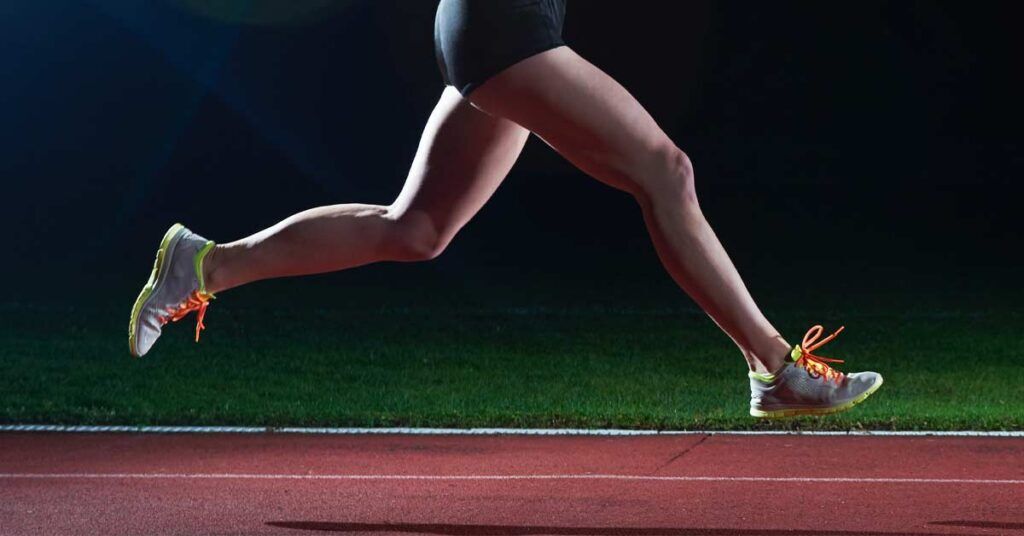
I use the example of standing over a high speed treadmill, if you place one foot on this treadmill slowly, what will happen is that the foot will be whisked behind you very quickly, this is what is happening when you are covering the ground at 9+m/s – every millisecond longer on the ground results in the foot ending up further behind your centre of gravity before you can pull it off the ground for the next stride cycle.
Also once the athlete has reached their maximal running velocity, the athlete has little reduction in speed when in the air (air resistance is negligible) and so it is only when the foot touches the ground that the athlete will potentially slow down.
So combine the fact that you want the athlete to spend as little time on the ground as possible at top speed and that the forces at each ground contact are vertically up to 5-times body weight leads to the quandary of how do you develop the appropriate “speed strength” to allow the athlete to apply these vertical forces in the time they have (<100ms).
Further complicating this challenging physical requirement is that a more detailed force analysis of elite versus sub-elite sprinters show that within the <100ms available to apply force, the elite of the elite are able to apply higher forces in the first ~30% of the time on the ground (~30ms).

TEACHING VERTICAL FORCE APPLICATION
Many years ago I was fortunate to spend several months with at the time, two of the best sprint coaches in the world:
Dan Pfaff – coach of Donovan Bailey (9.84WR, 1996 Olympic Champion), Bruny Surin (9.84), Obadele Thompson (9.87, 19.97).

John Smith – coach of Maurice Green (9.79WR, 2000 Olympic Champion) Ato Boldon (9.86, 19.77), Jon Drummond (9.92), Marie Jose Perec (48.25, 1996 Olympic Champion).

Interestingly they took quite different approaches to this vertical force application requirement. Smith would focus on knee drive (using Newton’s 3rd law – for every action (knee drive) there is an equal and opposite reaction (opposing leg driving to the ground) whilst Pfaff would have his athletes actively drive their feet into the ground (with almost flat feet) in an effort to maximise ground reaction forces and use the elasticity of the ankle joint to rebound the athlete off the ground to the next stride.
Pfaff was more scientific of the two coaches and talked at length about the ground reaction force requirements of elite sprinting (it wasn’t until 15 years later that research fully backed up his early views on force application to the ground (vertically) and impact upon maximum running velocity).
Force application should be in the same direction relative to body position regardless of the section of the race. What do I mean by this?
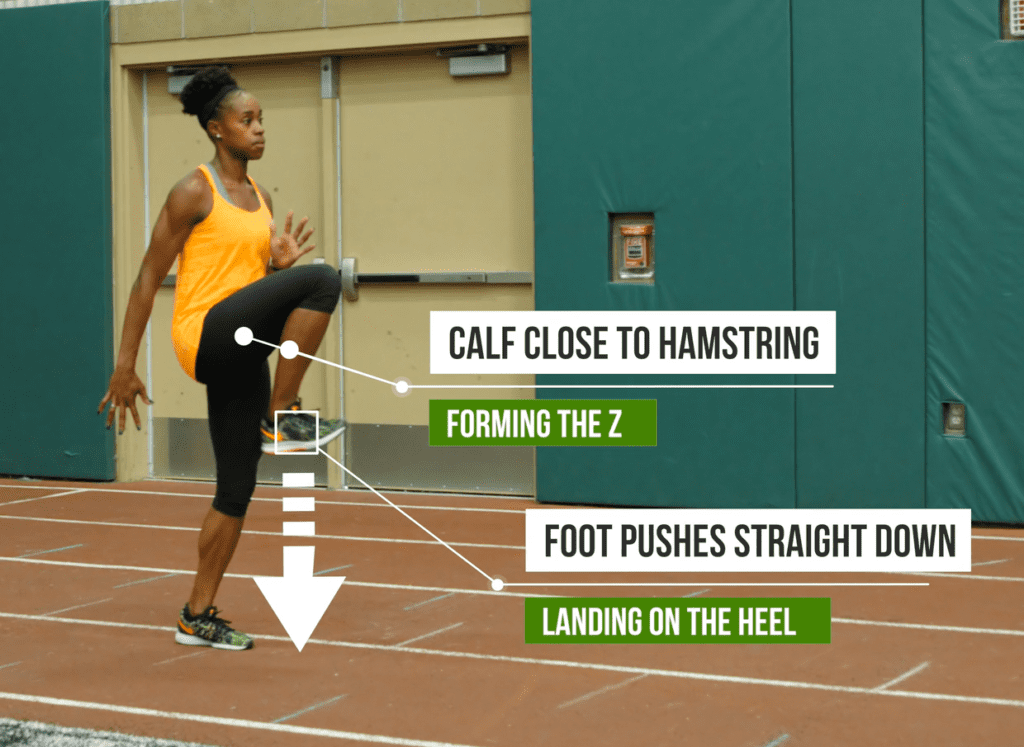
When accelerating from the blocks – the athlete should focus on good thigh/foot recovery and then a forceful drive back to the ground whilst at top speed the athlete should be focusing on driving their foot into the ground directly under their COG.

Relative to the athlete’s torso – both athletes are driving their thighs in largely the same direction.

Drills are key
What I typically see in my day to day coaching is athletes of all ages going through the motions with their drills as part of their warmup.
What I emphasis with my athletes is that the warmup and associated drills are an important component of the total training session (not something to get out of the way as quickly as possible).
As such I have my athletes spend quite a bit of time during their warmup performing sprint drills (Skipping & Running A’s, B’s, rapid leg switches, single leg stiff ankle bounds, etc).
It is during this early phase of the general preparation phase that you can work on and reinforce the correct limb mechanics to maximise the athlete’s capacity to dynamically drive their foot into the ground and generate the required ground reaction force in as short a time as possible.
Mechanics whilst running/sprinting
The second phase to developing the appropriate sprint mechanics is in the reinforcement of the correct limb positioning during all running sessions.
This start with athletes having to perform the correct limb positioning during tempo runs (these allow the athlete to clock up a lot of volume with medium intensity with a focus upon good knee lift and vertical force application).
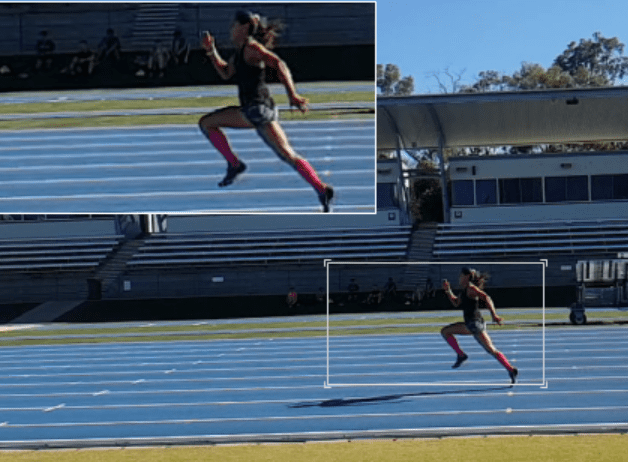
You will be amazed how quickly a well conditioned athlete can become fatigued when you ask them to maintain the correct pelvic, hip, knee & ankle positions whilst trying to run a 200m or 300m tempo repetition!!
In my experience, as fatigue sets in (this can be neural fatigue over 100m – not just metabolic fatigue you might see over 400m), the athlete will subconsciously try to increase their impulse by increasing their time on the ground (Impulse = force x time).
If this happens two technical faults will creep into their movement pattern:
1. They will start to anterior pelvic tilt as their leg stays on the ground for longer resulting in a lower front knee height position, and
2. Their mechanics will start to become more “rear sided” rather than the preferred front side sprint mechanics.
Whilst this might allow the athlete to apply more force, it leads to very poor mechanics, increased ground contact times, increased exposure to hamstring injury and overall incorrect force production mechanics for effective and efficient sprinting.
Vertical Load Generation & Tolerance
A key conditioning goal for all coaches of sprint athletes is to:
a. develop the appropriate strength/power to allow the athlete to generate the sorts of forces required at each ground contact, and
b. to develop the musculoskeletal system throughout the body to tolerate these loads with no collapse.
A mainstay of all strength and conditioning programs is that of the traditional squat (+/- 90o knee angle). As someone who has worked in the S&C space for >30 years I would like to put it out there that squatting is not a leg exercise, it is a core exercise!!
Why do I say that? As an experiment, have any of your athletes trial a 2RM squat maximum, then have them replicate the 2RM max test on an incline leg press machine – In 99% of cases the athlete will be able to leg press 2X+ what they can squat, so if squatting is a leg exercise why can’t they squat as much as they leg press? It is because the core is the limiting factor in squatting, not the legs. So if traditional squatting is your primary leg strengthening exercise for your athletes, then you are effectively developing ~50% of their leg strength potential doing this exercise only!!!
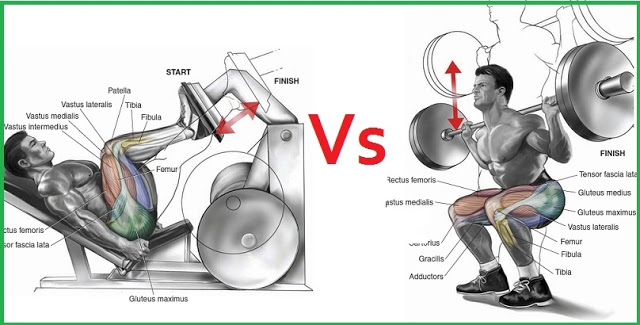
Of course I understand that the majority of coaches don’t just have their athletes squat, but I do see a high emphasis on the squat movement when there are many other movements that are much more effective to develop the required strengths for effective sprint performance.
Back to our force generation and load tolerance dilemma.
The key force generation movement for sprinting is that of hip extension (gluteals, hamstrings). The faster and more powerfully the athlete can generate a high level of angular velocity through the hip joint on the way to their foot hitting the ground, the more effective they will be at generating high running velocity at top speed. An old, but great study completed at the 1991 World Athletics Championships in Tokyo showed that the first and second place holders (Lewis 9.86, Burrell 9.88) had one main kinematic trait that separated them from all the other sprinters in the race, that was a superior hip extension angular velocity.
To maximise this kinematic capacity in our athletes, we must develop two attributes:
1. The ability to rapidly switch from a hip flexion to hip extension movement, and
2. The ability to forcefully drive the thigh into the ground with as much speed and power as the athlete can generate during their ~4.5strides per second!!
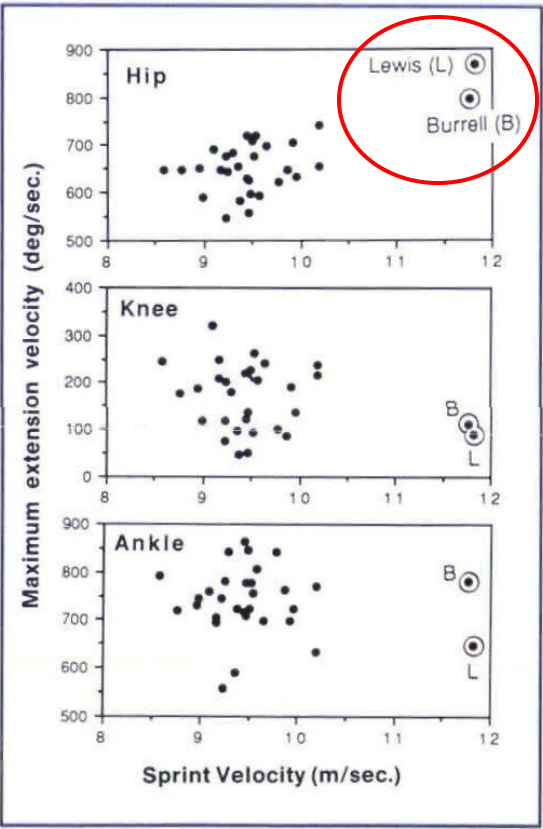
To work on this rapid hip extension, there are several gym exercises that can be used to begin teaching your athletes to perform this dynamic high velocity hip extension movement:
1. Cleans/Snatches – There is a high technical component to these movements and unless the athlete is trained appropriately, these exercises doesn’t activate the hip extensors anywhere near as well as can be achieved with less technical exercises.
2. Dynamic Step ups – Important here is the term Dynamic, a few of my athletes feel the traditional step up is too quad dominant (particularly if the box is too high), so for raw strength we would only step up onto a low box (20cm-30cm) with a high weight (see below for more information on this topic).
But if you want to develop dynamic hip extension strength, then dynamic stepups are a good addition to your routine.
A dynamic step up is one whereby the athlete attempts to drive their foot into the ~15cm box/step as fast and as hard as they possibly can, with a focus on rapid hip extension and hitting the box/step with a flat foot (Dorsiflexed ankle).
This drill is excellent for teaching the athlete to drive vertically down from the hip flexion position. Initially body weight is more than enough to load the athlete, but as the athlete improves you can then start to add weight.

Whilst the above exercises address the rapid hip extension component and Pfaff is very interested in what he calls the “switching mechanism” of the hip – the ability to be able to go from a rapid hip flexion to a rapid hip extension. Now of course sprinting regularly will assist with this drill but I use another exercise that is as much a core exercise as a switch mechanism exercise – and that is the Roman Chair leg switch exercise.
I like this exercise for a couple of reasons:
1. The athlete can focus on a strong posterior/neutral pelvic tilt whilst doing the exercise – thereby reinforcing the correct pelvic positioning when sprinting at speed, and
2. There is great immediate biofeedback, if the athlete performs this exercise well, the force generated will lead to a major shake of the apparatus they are using.

I like to start with two switches (one full stride) and over time as their coordination and conditioning improves, we increase that to 3, 4, 5, etc.
The athlete can really focus on being rock solid through the core whilst trying to move the limbs as quickly as possible through a complete stride (or more).
The second factor, Load Tolerance, is related to the capacity of the athlete to not “buckle” when the foot hits the ground at maximum velocity. Recent research has clearly shown that the faster you sprint, the higher the Ground Reaction Forces (force that the athlete applies to the ground) they will experience.
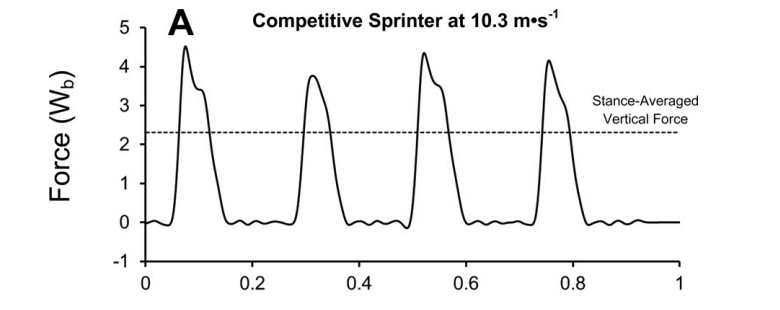
Research by Weyland and Clark (2014) highlighted that elite sprinters will generate up to 5X bodyweight at each ground contact (a 70kg sprinter will have to tolerate 350kg on a single leg!!!). It is not only the legs that need to be able to tolerate this force, it is the entire musculoskeletal system (particularly hips/torso) that needs to be incredibly strong not to collapse at ground contact, but to use it to propel the body to the next step.
Whilst not a revelation, it is hopefully obvious that single leg gym work should offer the solutions to the above problems.
There are a few reasons:
a. If you lift using a single leg, the weight your torso can tolerate will be closer to the maximum of a single leg, and
b. Single leg training will closer replicate the movement patterns that simulate sprinting, and
c. Single leg exercises lead to greater activation of the hamstrings and in particular the gluteus medius muscle groups (which are vital in the stabilisation of the hip & knee joints at ground contact).
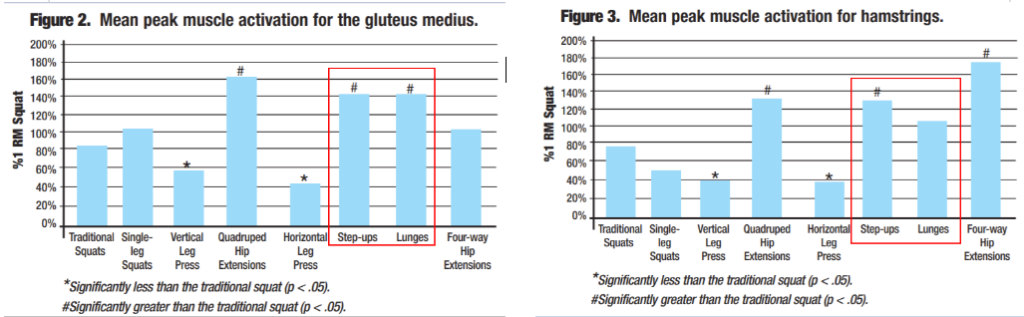
I highlight stepups and lunges as these are the easiest exercises to load your athletes (using traditional bars/dumbbells). The 3rd exercise that is shown to be very good for both gluteus medius and hamstring activation is that of the Quadruped Hip Extension.
It is an exercise that is more difficult to load the athlete, but can be done with bands, but is a great general conditioning and warmup exercise.
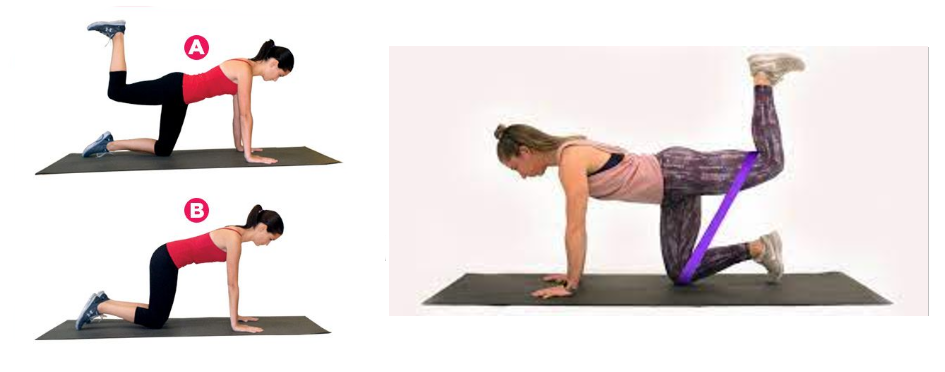
A variation on this exercise is the single leg hip thrust and this is where you can start to really load up your athletes and have them focus on strong and powerful single leg hip extension movements.
Important to get some quality coaching with this exercise as it is easy to start using the wrong motor patterns to lift heavy weights off the ground.

Tolerating the GRF at maximum velocity.
This is of particular interest in that there has been some very creative attempts made to improve the athlete’s tolerance to these high vertical loads at ground contact.
Key aspects to note are:
1. The body is largely in an upright position with only small joint angles at knee & hip.
2. The forces are largely vertical.
3. The load isn’t limited to the lower limbs, the pelvis/torso if not strong will also collapse resulting in an ”absorption” phase at ground contact, increasing GCT & decreasing GRF.
What I would like to say at the outset is that deep squats are not the solution to improving this aspect of sprint performance. The benefit to be had from this exercise is in the improvement in total core stability – but there is little specificity in performing a squat over a 45o ROM when you are looking at an almost isometric tolerance at very small joint angles when sprinting at maximum velocity.
Some of the more creative attempts at improving this joint specific strength include:
1. Low Step Ups with Heavy Load
Key here is to keep the box height low (no more than 15-25cm).
What you want to do is to dynamically stepup as quickly as you can with a heavy weight train the entire system to tolerate single leg loads whilst performing a small hip extension movement.
I have a strong memory of the great Arto Bryggare (Finnish 110m Hurdler) performing dynamic stepups with 240kg on his back!!!
He was so dynamic at ground contact that the bar would flex up and down for a couple of seconds after each step!!!

2. Small range squats
This is a two leg version of the dynamic stepups.
You lift a significant weight and then only squat a few degrees (10-15degrees) with a focus on tolerating the vertical load and as explosively as you can extend to a full upright position.
This exercise is much harder on the spine due to the high loads you need to lift.

This type of training is highly neural. As an example, an athlete of mine many years ago was keen to experiment with this small range training to see the effect upon his sprint performance. After our first session of small range squats with 250kg (he was only 68kg in body weight) he was telling me that he went out to dinner with his family after training and fell asleep at the table!!!!
3. Isometric Training
Isometric training has a small effect a few degrees either side of the angle at which you train and so by loading the body isometrically at a range of around 10o from anatomical position, in theory you can develop very high load tolerances throughout the entire anterior and posterior chains specific to sprinting.
As an example, again many years ago, the AIS looked at isometric force production capacities with some of their T&F athletes and one result was a female mid 50kg in weight, able to generate close to 250kg in vertical force against an immovable bar. So being able to have athletes generate huge isometric forces in the right body position may also be a way of getting the body to adapt to the large vertical forces it will experience particularly at maximum running velocity.

The other interesting trial was single leg isometric holds with a focus on holding the ankle in a neutral dorsiflexed position off a step – again with the goal of trying to improve the tolerance of the main joints in the body to the GRF that they will experience during a sprint race.
4. Plyometrics
You can’t have a discussion around developing and tolerating GRF’s without talking about plyometrics.
Plyometrics is the rapid stretching and shortening of muscles around one or more joints with a focus on improving both the tolerance to load and improved stretch shorten cycle (stretch reflex) that can provide some “free” force generation through whatever movement you are undertaking.
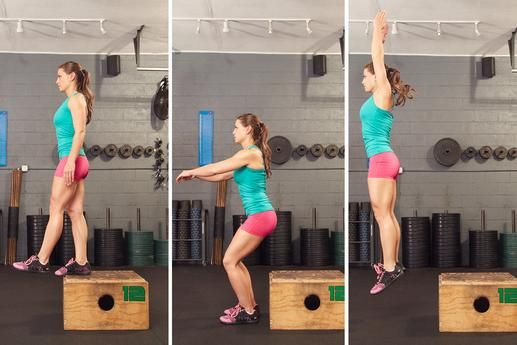
I will continue this discussion in Part 3 with a more in depth review of plyometrics (science and application) and how to develop an appropriate plyometric routine that will enhance your athlete’s capacity to both tolerate and increase GRF’s during their sprinting performance.
References:
Weyand PG, Sternlight DB, Bellizzi MJ, Wright S. Faster top running speeds are achieved with greater ground forces not more rapid leg movements. J Appl Physiol 81: 1991–1999, 2000.
Weyand PG, Sandell RF, Prime DN, Bundle MW. The biological limits to running speed are imposed from the ground up. J Appl Physiol 108: 950 –961, 2010.
Kenneth P. Clark and Peter G. Weyand Are running speeds maximized with simple-spring stance mechanics? J Appl Physiol 117: 604–615, 2014.
To apply as much vertical force down into the ground as possible, in as brief a ground contact time as possible, while staying as stiff as possible all the way up the kinetic chain.
.
STRIDE LENGTH (SL)
All the recent research suggests that SL is the differentiating factor b/w elite and sub elite athletes (SF are often similar in these two groups even though max velocities and performance times are significantly better in the elite cohort (clark & Weyland 2014)). Also a well referenced study in the 1990’s stated “85% of running velocity variance is explained by variance in Stride Length (not Stride Rate)”. Delecluse et al 1995.
If we take this to be true, then as sprint coaches, we need to do all we can to maximise the athlete’s capacity to increase their SL and this comes back to the development of the most appropriate limb kinematics (leg positioning under the COG to minimise breaking impulses – not having the athlete reach out as is often the goal by many beginner sprint coaches) and apply the greatest force possible into the ground (kinetics) in the shortest time to a) overcome gravity and b) continue to propel the body across the ground.
The challenge here is we are trying to improve the athlete’s capacity to generate high IMPULSE during a short ground contact.
IMPULSE = Force x Time.
This equation means that there are two ways of increasing your IMPULSE, you can increase force or increase the time you apply the force.
During starts and early acceleration, you have the time to apply force (Time) but as you start to reach maximum velocity, you now just don’t have the time to apply the force required so therefore you must try apply as much force as possible in less time (typically <100ms). This requires very specialised strength and power training routines to achieve this force-time capacity.
As outlined in one of my earlier articles (Maturation and sprinting), the young and not strong sprint athlete will try to increase the time on the ground to make up for the lack of force. This unfortunately results in them leaving their foot on the ground for too long resulting in rear sided sprint mechanics (and all the associated dangers with this technical model).
The entire conditioning program for sprinters should be based on developing the attributes that achieve these above goals.
PLYOMETRICS
I completed a post graduate thesis in the 1990’s (Sprinting kinematics between sprinting and plyometrics) and the study in question looked at several plyometric exercises, Countermovement jump (Slow stretch shorten cycle), high speed alternate leg bounds and high speed single leg hopping (Fast stretch shorten cycle) and compared these characteristics to maximal velocity kinematics (subjects included almost all the best 100m sprinters in the country at the time).
The outcome of the study showed that there was a strong correlation b/w high speed alternate leg bounding ground contact times and elite sprint performance (particularly the acceleration phase) and a weak correlation b/w High speed single leg hops and elite performance (more to do with the lack of the elite sprinters in the group who undertook this form of plyometric exercise).

What was of interest and largely confused the issue was that the current best sprinter of the group didn’t do any plyometrics at all, whilst the second best sprinter was the best bounder I had ever seen (indicated by an average hop length of >4.00m during his Single Leg Bounds!!). It wasn’t in the scope of the study to look at these individual variances but would have been very interesting to evaluate the strengths of these sprinters and how they ended up with similar outcomes from very different paths. Many roads lead to Rome!!!
What was clear from the study was that even those International class sprinters who didn’t do a lot of plyometics were still really good at plyometrics!!! It was more of a coordination issue with them during the testing than actual power output.
If we analyse High Speed Single Leg Hops, the kinematics of each limb is quite similar to that in sprinting (high knee position and rapid hip extension into the ground with resulting vertical GRF). Whilst often with ALB (particularly when the emphasis is on distance alone) you will see athletes get long with their stride resulting in more horizontal force production, less vertical GRF and increased horizontal breaking forces (suggesting that ALB’s are better for the acceleration component of the sprint where as the Single Leg ALB is more a top speed plyometric).
.
One way of determining which plyometric exercises you should incorporate into your routines can be through better understanding GCT’s during different phases of the sprint performance.
SPRINTING GCT
Sprinting Phase
- Block Starts
- Acceleration
- Top Speed
GCT
- 250ms-300ms
- 170ms-120ms
- <100ms
If we look at the kinematics of the typical plyometric exercises we see used, we can start to get a clearer picture as to what is suitable for which part of the race and time of the year.
PLYOMETRIC GCT
- Squat Jumps
- CMJ
- Depth Jump variations
- Stiff Ankle bounds
- ~30cm Box Jump to 30cm Box rebound
- 400ms
- 350ms
- 200ms-300ms
- 130ms-170ms
- 130ms-150ms
*A progression can be from a 2-foot landing/take off to 1 foot landing/take off.
Many of the plyometrics we have our athletes undertake are not very sprint specific (in terms of GCT) but do improve the athlete’s tolerance to increased GRF and thereby strengthen the entire musculoskeletal system to the load demands in sprinting. As an example, I added “shock jumps” to one of my elite athlete’s program many years ago, this included stepping off varied height boxes (up to 120cm) and landing on the ground with minimal collapse (and no rebound) – the GRF’s through the body were very high and this exercise improved this athlete’s ability to tolerate the GRF’s experienced during his sprinting/hurdling performances.
Plyometrics increases muscle stiffness (less compliance) resulting in a greater force being generated through the tendon (greater stretch, faster recoil). Plyometric training also reduced neural inhibition at ground contact. Hirayama et al 2017. Whilst heavy strength training increases tendon stiffness allowing more of the tension to be placed upon the tendon with its high force generation capacity.
It makes sense to periodize these two key training modalities (strength and plyometrics) in a way that they complement each other. There has been numerous papers over the past 30-years showing the benefits of combining strength with plyometric type activities in a gym setting.
An example strength/plyometrics routine we are going to experiment with in the off-season consists of the following combination:
Heavy small range Bulgarian split squat (10-15o) – 3-5 reps/leg – immediately followed by 30cm single leg drop jumps with immediate hop back up to another 30+cm box (with the goal of the ground contact times being ~100ms and the largest height rebound possible).

The small range Bulgarian Split squats assists with the hip and knee joint stiffness whilst the single leg box drop jump-rebounds assists with ankle stiffness. Any collapse throughout the foot-ankle complex will prolong ground contact time, decrease stiffness, and generally not provide the desired training benefit.
This routine deals with the two key aspects of sprint kinetics that is key for high level performance:
a. The body has to remain stiff in the two main anatomical planes:
Sagittal Plane – ankle and knee
Frontal Plane – hip/pelvis
Too much compliance in these planes leads to decreased force production and increased GCT (neither are optimal).
b. High force generation in short contact times – single leg drop jumps with rebound are a great way of training this physical modality (it is important to have a rebound as athletes may try to decrease their ground contact by applying less force and just pulling the foot off the ground – by requiring an effort to jump up onto another height you remove this potential technical fault).

1 leg vs 2 leg Plyometrics
There has also been a lot of research on the value of single versus double leg plyometrics for power generation and elite performance See recent paper – Bogdaniset al 2019.
This paper stated that unilateral lower limb plyometric training was effective at improving both single and double-leg explosive performance, while an equal volume of bilateral training only improved bilateral performance (and as sprinting is a unilateral movement it is clear that single leg plyometrics are key to maximising overall sprint performance).
If we think about the athlete’s entire musculoskeletal system when programming these sorts of exercises it makes sense to be as movement specific as possible as there are increased loads placed upon in particular the hip/pelvis region when an athlete is required to complete single leg jumping exercises compared to much more stable double leg varieties.
Immediately there is a larger emphasis on frontal plane stabilisation with single leg plyometrics (including key muscles such as gluteus medius, quadratus lumborum and adductors).
If there isn’t the concomitant increase in frontal plane stabilisation strength with any increase in overall plyometrics strength, then much of this “power” improvement will not be accessible due to poor force transmission at ground contact (through pelvic collapse and power leakage throughout each ground contact).

So where possible try to incorporate single leg plyometric jumping activities as this is more movement specific as well as better for total body stability and coordination development.
If you take this approach then you do need to be careful as the loads being placed unilaterally are very high – taking a conservative approach to both intensity of impacts and volumes are key to ensure that the athlete adapts with minimal over-training.
Some example exercises that can start to prepare your athletes for more advanced plyometric routines include:
- Single leg pogos in warmup
- Mini hurdle single leg hops
- Skipping
- Forward/lateral/backward hopping
- Mini box jumps (on and off).
- Dynamic step Ups

All the above exercises allow the musculoskeletal system (particularly in the ankle) to begin to adapt and tolerate the repeated impacts. With many of these exercises I will have the athlete forcefully drive their feet into the ground (with a focus on good technique – dorsiflexed ankle, flat foot) with as much focus on musculoskeletal tolerance over time as improvement in plyometric ability.
Whilst it is an old story, I remember once reading that Pietro Mennea (former 200m world record holder and Olympic 200m champion) would perform all his plyometrics with a focus on trying to keep his GCT below 100ms. If anyone has been lucky enough to see this man run live, it was a beautiful thing – he seemed to just float across the track….
.
PRACTICAL EXAMPLES:
Sprinting light footed!!
One thing I have noticed with certain athletes is an ineffective force application when running across the ground. The athlete may look light across the ground and technically proficient but aren’t actually running fast – If you could easily measure the kinetic variables of these athletes (in particular their GRF) I would guess that they are not hitting the ground very hard and are just floating across the ground without applying the levels of GRF that are required to run truly fast….
I worked with such an athlete, looked beautiful when running but did not generate the maximum velocities that would be expected based on her physical appearance during sprinting.
It is these athletes that I believe a targeted high strength/plyometric routine can be of huge benefit. They already have the basic mechanics, you just need to increase their engine capacity (strength/power) to have them begin to reach their maximum velocity capacity.
.
Strong versus wiry Athlete
We are all familiar with the different builds of our sprint athletes, some are very strong/muscular whilst others struggle to gain any muscle mass but are still very fast.
A good question to ask is: Which athlete type benefits from weights versus plyometrics/speed type training?
As a general guide I would try to increase a strength athlete’s plyometric ability whilst working on increasing the raw strength of the more wiry type athlete.
What can happen with strong athletes is that they have often gotten strong through the use of weight training and typically strength training is slow – which is required muscle physiology to generate maximum force when lifting.
If you look at this typical Force-Time curve, you see that strong athletes (green) need time to generate the high levels of strength that they possess – this is problematic for the sprint athlete as you only have this time in the first 1-2 steps and then rate of force development becomes more important.
The high rate of force development athlete can lack the absolute force required so this is why it is important to determine which type of athlete you are working with as this will then dictate the sort of training to have them undertake during preparation phase training.

Sprinters with Hamstring Issues
There are a small number of sprinters who suffer from regular hamstring issues with sprinting. I have previously addressed this issue as often being related to poor sprint mechanics but also this can be an issue with force generation during the sprint cycle and improper conditioning routines to prepare the athlete’s musculoskeletal system for these loads.
As an example, there is a view that some hamstring tears are preceded by a high force co-contraction at ground contact phase resulting in the hamstring then straining whilst completing the swing phase of the stride cycle.
This high level of co-contraction and rapid braking of a high hip extension velocity creates very high stress levels throughout the hamstring muscle group causing potential microtear and neural overloading which is then presented as a strain in the subsequent swing phase.
This can definitely be exacerbated by poor sprint mechanics, as an example landing too far forward of your COG at ground contact will create horizontal breaking forces and will also require the athlete to have to overcome these breaking forces by increasing force production by largely the hamstring muscle group to overcome the incorrect ground placement. It is just a matter of time for the hamstring muscle complex to fail under these conditions. Another reason why the focus on developing the best sprint mechanics as possible with your athletes is a key goal to both sprinter health and ultimate performance.
Hopefully these papers have given you something to think about as you go about preparing your athlete for the upcoming season and I wish you all the best with your coaching.
Adrian Faccioni
REFERENCES
1. Plyometric Training Favors Optimizing Muscle–Tendon Behavior during Depth Jumping.
Kuniaki Hirayama, Soichiro Iwanuma, Naoki Ikeda, Ayumi Yoshikawa, Ryoichi Ema, Yasuo Kawakami. Front. Physiol., 25 January 2017
2. Comparison Between Unilateral and Bilateral Plyometric Training on Single- and Double-Leg Jumping Performance and Strength. Bogdanis, Gregory C.1; Tsoukos, Athanasios1; Kaloheri, Olga1; Terzis, Gerasimos1; Veligekas, Panagiotis1; Brown, Lee E.2 Journal of Strength and Conditioning Research: March 2019 – Volume 33 – Issue 3 – p 633-640
3. Kinematics of Maximal Speed Sprinting With Different Running Speed, Leg Length, and Step Characteristics. Kenji Miyashiro, Ryu Nagahara, Kohei Yamamoto and Takahiko Nishijima. Front Sports Act Living. 2019; 1: 37.
4. Post Activation Potentiation of sprint performance using ALB + 10%.
Turner, AP, Bellhouse, S, Kilduff, LP & Russell, M 2015, ‘Postactivation potentiation of sprint acceleration performance using plyometric exercise’, Journal of Strength and Conditioning Research, vol. 29, no. 2, pp. 343–350
5. Sprint Kinetics, Kinematics, and Training Application with Ken Clark.
https://simplifaster.com/articles/sprint-kinetics-kinematics-ken-clark/
No responses yet